




Regulatory Scenario Analysis
Anticipate sustainability and circular economy regulations before they fundamentally transform your industry.
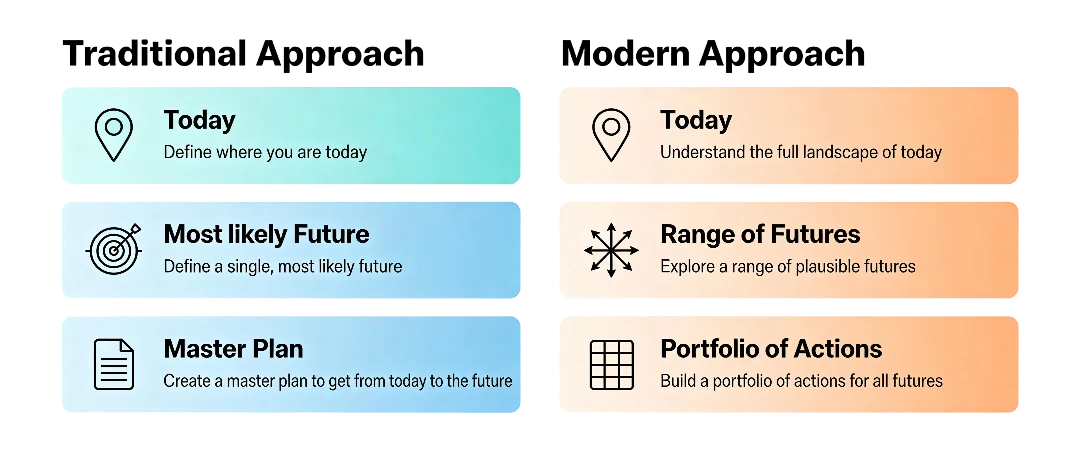
Conventional planning tools are designed for predictable environments—yet current regulatory conditions are disjointed, rapidly evolving, and frequently ambiguous. Scenario planning enables organizations to examine potential developments, assess their implications, and determine proactive steps to maintain a leading position.
Convert uncertainty into a competitive edge.
Our methodology moves beyond theoretical futures, providing actionable intelligence and commercial initiatives that equip you to steer through disruption, rather than follow it.
How prepared is your organization for the forthcoming surge of sustainability-related legislation?
The emphasis of regulations is transitioning from observation and disclosure to verifying tangible advancement along the Net Zero trajectory.
Regulations will directly influence expenses and redefine how products are packaged, marketed, and reclaimed—businesses must adapt promptly to mitigate financial penalties and operational interruptions.
7 out of 10 senior leaders regard impending stricter regulations as a primary catalyst for their sustainability strategy and business model transformation efforts.
The regulatory environment for sustainability and circularity is intricate and multifaceted.
Regulations are evolving at varied stages and will affect distinct sectors unevenly—ranging from introducing administrative overhead to mandating fundamental, strategic transformation.
LOW
Organizational Implications
HIGH
Marginal adjustment
FOUNDATIONAL REPORTING
Mandates organizations to establish data infrastructure and compile standardized reports disclosing fundamental environmental or social metrics.
Intermediate adjustment
COMPREHENSIVE DISCLOSURE
Demands thorough analysis and evaluation for the complete and detailed reporting of sustainability-related risks, impacts, and strategic responses.
Significant operational transformation
ACTION-ORIENTED COMPLIANCE
Enforces defined measures or performance criteria to lessen environmental or social impacts, and/or requires modifications to operational procedures and supply networks.
Fundamental organizational change
STRATEGIC INTEGRATION
Compels businesses to incorporate sustainability into their central strategies and decision processes, prompting a re-evaluation of long-term viability and organizational purpose.
Preparing for Multiple Regulatory Scenarios — A More Strategic Approach to Planning
Clarity amid uncertainty. Precise predictions are not required to make more informed strategic choices.
Our methodology builds resilient strategic alternatives and examines potential policy impacts. We facilitate agile, evidence-based planning that aligns executive vision, drives stakeholder commitment, and enhances competitive positioning within evolving regulatory environments.
THE ADVANTAGES OF scenario Planning for Building a More Sustainable Future
Breaking away from linear logic
Upcoming circular economy regulations disrupt conventional take-make-dispose frameworks. Scenario planning compels organizations to reimagine operations, value networks, and growth through a circular perspective—before regulatory mandates impose change.
Aligning stakeholders for compliance and transformation
Scenario planning unites sustainability, legal, commercial, and operational teams around common regulatory outlooks—fostering commitment to proactive adaptation and building organizational readiness.
Enabling quicker, more strategic reactions
Amid evolving policies and uncertain timelines, scenario planning prepares strategic alternatives ahead of time—allowing your business to respond more rapidly and decisively when change arrives.
Connected expertise and service offerings
Sustainability Framework
Incorporate sustainability as a fundamental component of your central strategy to activate value generation, direct innovation, and ensure enduring expansion.
Competitive War Gaming
Evaluate the real-world and commercial implications of competitor actions to develop strategies that secure a lasting competitive advantage.
Diagnostic of Circular Value Chains
Identify where value erodes and pinpoint where circular initiatives can generate competitive advantages.